Most talk about gaming hardware describes the PC people wish they had. The numbers describe the one they own. The average gaming PC specs in 2026 are more modest than any launch-day review suggests: a mid-range graphics card from a past generation, 16GB of memory, and a 1080p screen.
This page collects the hardware statistics that matter, each one traced to the organization that produced it, with the date and a link. The core source is Valve’s Steam Hardware & Software Survey for August 2026, a monthly opt-in survey of the computers that run Steam. It is updated here every month when Valve publishes new data. Last updated: September 21, 2026.
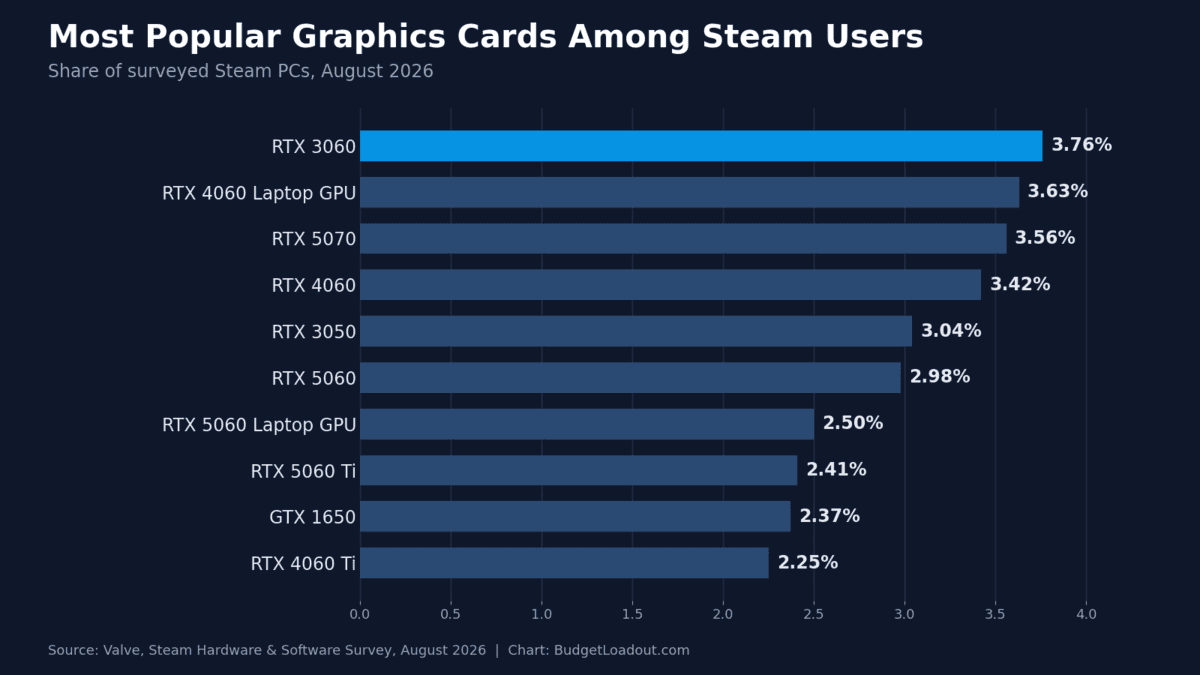
- The most-used graphics card on Steam is the NVIDIA GeForce RTX 3060, at 3.76% of surveyed PCs (Valve, August 2026).
- 50.52% of Steam users play at 1920 x 1080. 2560 x 1440 is second at 21.86%, and 4K sits at 4.98% (Valve, August 2026).
- 16GB is the most common amount of system memory at 41.20%, with 32GB close behind at 37.45% (Valve, August 2026).
- On Windows, Intel processors are in 54.47% of Steam PCs and AMD processors in 45.52%, up from 44.18% in April (Valve, August 2026).
- 70.97% of Steam PCs run Windows 11 and 22.90% still run Windows 10 (Valve, August 2026).
- The most common processor has 8 cores (28.04%), followed by 6 cores (27.43%) (Valve, August 2026).
- 16GB is now the most common amount of video memory at 26.92%, ahead of 8GB at 25.74% (Valve, August 2026).
- The Meta Quest 2 (26.97%) and Meta Quest 3 (26.01%) are nearly tied as the most-used VR headsets on Steam (Valve, August 2026).
- 12.5 million desktop graphics cards shipped worldwide in the second quarter of 2026, up 10.0% from the previous quarter (Jon Peddie Research, September 2026).
- 212.3 million Americans play video games every week, and the average player is 37 years old (Entertainment Software Association, June 2026).
- Americans spent $60.7 billion on video games in 2025, including $5.4 billion on hardware and $2.95 billion on accessories (Entertainment Software Association, 2026).
Table of Contents
What Are the Average Gaming PC Specs in 2026?
The most common gaming PC on Steam runs Windows 11 on an 8-core or 6-core processor, with 16GB of memory, a graphics card in the RTX 3060 class, and a 1920 x 1080 display. That is a composite of the single most common answer in each category of the August 2026 survey, not one machine Valve has measured.
| Component | Most common answer | Share of surveyed Steam PCs |
|---|---|---|
| Operating system | Windows 11 64 bit | 70.97% |
| Graphics card | NVIDIA GeForce RTX 3060 | 3.76% |
| Video memory | 16 GB | 26.92% |
| Processor cores | 8 cores | 28.04% |
| System memory | 16 GB | 41.20% |
| Primary display | 1920 x 1080 | 50.52% |
| Total storage | Above 1 TB | 49.51% |
If you are pricing a build against those average gaming PC specs, our PC hardware hub collects the component guides, and our explainer on the average FPS for a gaming PC shows what this class of hardware delivers in games.
Is Your PC Above or Below Average?
The table below turns the survey into a quick benchmark. The Typical column is the range where most surveyed Steam PCs sit, so a machine inside it has typical average gaming PC specs. A part in the left column is the one most likely to hold your games back. A part in the right column puts you ahead of most of the Steam audience.
| Component | Below typical | Typical | Above typical | What the survey shows |
|---|---|---|---|---|
| Graphics card | GTX 1650, RTX 3050 or older | RTX 3060, RTX 4060 or RTX 5060 class | RTX 4070, RTX 5070 or faster | The RTX 3060 is the most common card at 3.76% |
| Video memory | 6GB or less | 8GB to 16GB | 20GB or more | 16GB (26.92%) and 8GB (25.74%) lead |
| Processor cores | 4 or fewer | 6 to 8 | 10 or more | 55.47% have 6 or 8 cores (our tally) |
| System memory | 8GB or less | 16GB to 32GB | 64GB or more | 78.65% have 16GB or 32GB (our tally) |
| Primary display | Below 1920 x 1080 | 1920 x 1080 | 2560 x 1440 or higher | 50.52% use 1920 x 1080 |
To check your own machine, open Steam and choose Help, then System Information. It lists the same categories Valve collects. On Windows, the Performance tab in Task Manager also shows your processor, memory and graphics card.
Falling below typical in one row is normal. The graphics card and the display decide most of what you see on screen, so those two rows matter more than the rest. A PC with an RTX 3060-class card, 16GB of memory and a 1080p monitor matches the most common answer in every row that affects games.
What Is the Most Popular Graphics Card?
The NVIDIA GeForce RTX 3060 is the most popular graphics card among Steam users, in 3.76% of surveyed PCs in August 2026. The RTX 4060 Laptop GPU is second at 3.63% and the RTX 5070 is third at 3.56%, according to Valve.
| Rank | Graphics card | Share | Change from July |
|---|---|---|---|
| 1 | RTX 3060 | 3.76% | +0.05% |
| 2 | RTX 4060 Laptop GPU | 3.63% | +0.19% |
| 3 | RTX 5070 | 3.56% | +0.16% |
| 4 | RTX 4060 | 3.42% | -0.01% |
| 5 | RTX 3050 | 3.04% | 0.00% |
| 6 | RTX 5060 | 2.98% | +0.13% |
| 7 | RTX 5060 Laptop GPU | 2.50% | +0.45% |
| 8 | RTX 5060 Ti | 2.41% | +0.15% |
| 9 | GTX 1650 | 2.37% | -0.11% |
| 10 | RTX 4060 Ti | 2.25% | +0.02% |
Every card in the top ten is an NVIDIA model, and seven of the ten carry a 60 in the model number. The newest generation is climbing quickly: on Valve’s video card page, the RTX 5070 rose from 3.01% of cards in April to 3.77% in August. That page reports slightly higher percentages than the summary table above, so compare its figures only with each other.
NVIDIA vs AMD vs Intel Among Steam Users
Adding up every model Valve lists by brand, NVIDIA cards account for about 68.85% of surveyed Steam PCs, AMD for about 13.84%, and Intel for about 5.59%. This is our own tally of Valve’s August 2026 list. The remainder is Apple silicon and cards Valve groups under Other (9.40%).
By generation, RTX 40 series cards make up about 18.67% of surveyed PCs, RTX 30 series about 17.89%, and RTX 50 series about 16.88%. Laptop graphics chips account for about 14.32% of the list. These are also our tallies of Valve’s data. For current picks see our best budget graphics card and best mid-range GPU guides.
How Much VRAM Do Gamers Have?
16GB is the most common amount of video memory at 26.92% of surveyed Steam PCs, narrowly ahead of 8GB at 25.74%. 12GB is third at 12.99% and 24GB accounts for 5.41%. About 49.15% of surveyed PCs have 12GB of video memory or more, by our tally of Valve’s figures.
The card most people own is two generations old. Buying guides should start there, not at the top of the range.
Do More Gamers Use Intel or AMD Processors?
Intel processors are in 54.47% of Windows PCs on Steam and AMD processors are in 45.52%, according to Valve’s processor data for August 2026. AMD’s share has grown from 44.18% in April 2026, while Intel’s fell from 55.81% over the same five months.
The most common processor has 8 cores (28.04% of surveyed PCs), followed by 6 cores (27.43%) and 4 cores (12.46%). About 56.92% of surveyed PCs have 8 cores or more, by our tally. Our AMD vs Intel for gaming comparison and best CPU for gaming guide cover what that means for a purchase.
How Much RAM Does the Average Gaming PC Have?
16GB is the most common amount of system memory, in 41.20% of surveyed Steam PCs, and 32GB is second at 37.45%. 8GB has fallen to 7.46%, and 64GB accounts for 3.97%, according to Valve’s August 2026 survey.
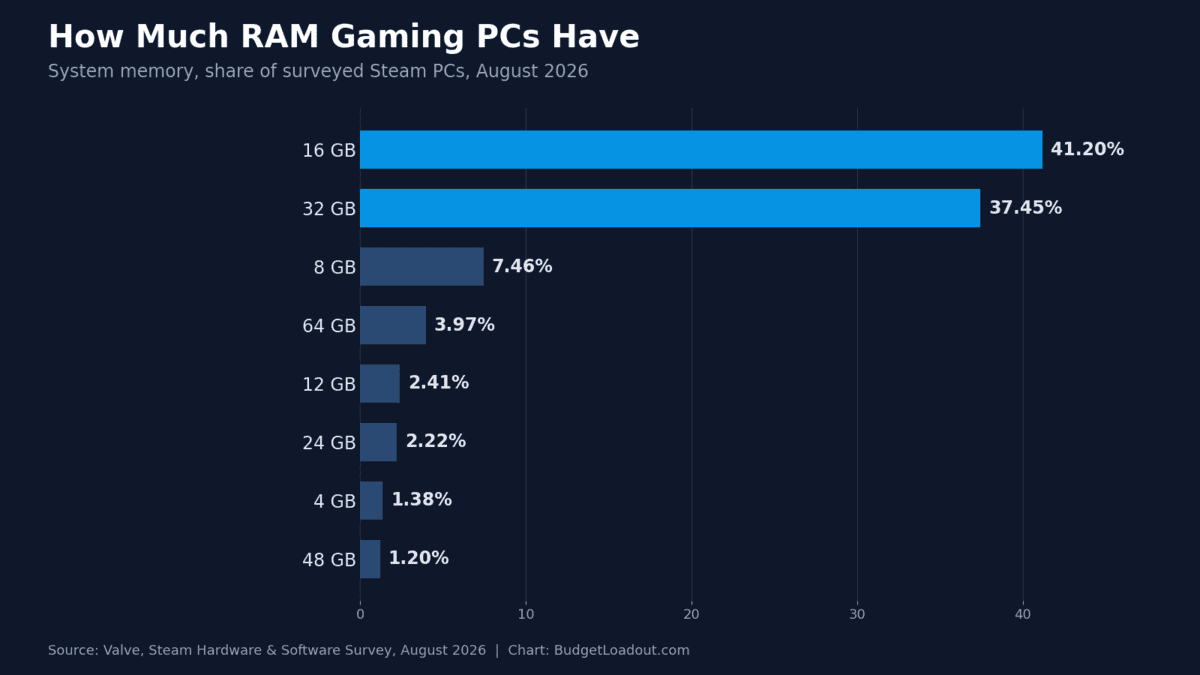
About 44.18% of surveyed PCs have 32GB or more, by our tally of the same data, so in memory terms the average gaming PC specs are moving from 16GB toward 32GB. In August alone, the 32GB share rose by 0.52 percentage points while the 8GB share fell by 0.52. Our guide to how much RAM you need for gaming and our DDR4 vs DDR5 comparison explain where the practical limits sit.
What Resolution Do Most PC Gamers Play At?
50.52% of Steam users have a 1920 x 1080 primary display, which makes 1080p the most common gaming resolution by a wide margin. 2560 x 1440 is second at 21.86%, 2560 x 1600 is third at 5.71%, 3840 x 2160 (4K) is at 4.98%, and the 3440 x 1440 ultrawide format is at 3.14%, according to Valve.
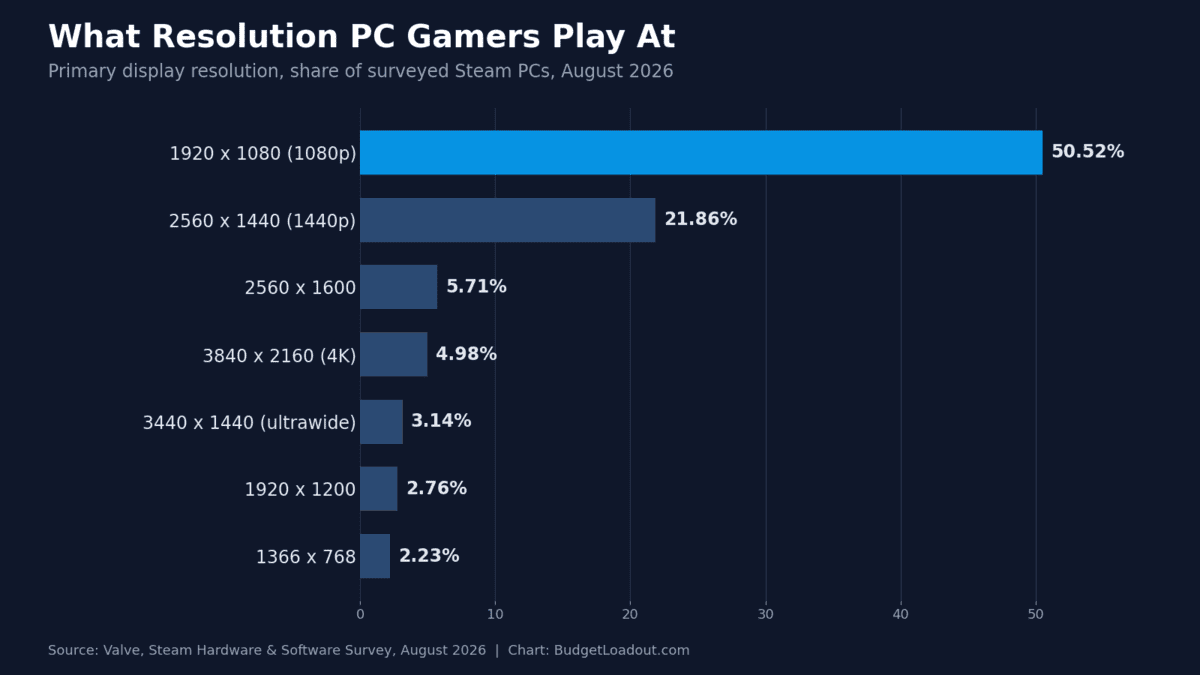
The direction of travel is toward 1440p. In August 2026 the 1080p share fell by 0.58 percentage points while the 1440p share rose by 0.40. Among users with more than one monitor, the most common combined desktop is 3840 x 1080, which is two 1080p screens side by side, at 47.62%.
Matching guides: best budget gaming monitor for 1080p, 1440p monitors, budget 4K gaming monitors, and budget ultrawide monitors. The monitor hub lists the rest.
Which Operating System Do PC Gamers Use?
Windows runs on 93.95% of surveyed Steam PCs. Windows 11 accounts for 70.97% and Windows 10 for 22.90%, according to Valve’s survey for August 2026. Linux is at 3.90% and macOS at 2.14%.
Within Linux, the largest single entry is SteamOS Holo at 0.82% of all surveyed PCs, which is the system that runs on the Steam Deck. If you are choosing a Windows edition for a new build, our Windows 11 Home vs Pro for gaming comparison covers it.
How Much Storage Does a Gaming PC Have?
49.51% of surveyed Steam PCs have more than 1TB of total storage. Another 24.67% have between 750GB and 999GB, and 17.69% have between 250GB and 499GB, according to Valve.
Free space is tighter than capacity suggests. The most common amount of free space is 100GB to 249GB (23.98% of surveyed PCs), and 16.80% have less than 100GB free. Our best SSD for gaming guide covers the upgrade.
Which VR Headsets Do PC Gamers Use?
The Meta Quest 2 is the most-used VR headset on Steam at 26.97% of connected headsets, with the Meta Quest 3 just behind at 26.01%. The Meta Quest 3S is third at 11.50%, the Valve Index fourth at 11.07%, and the Pico 4 fifth at 4.48%, according to Valve’s August 2026 survey.
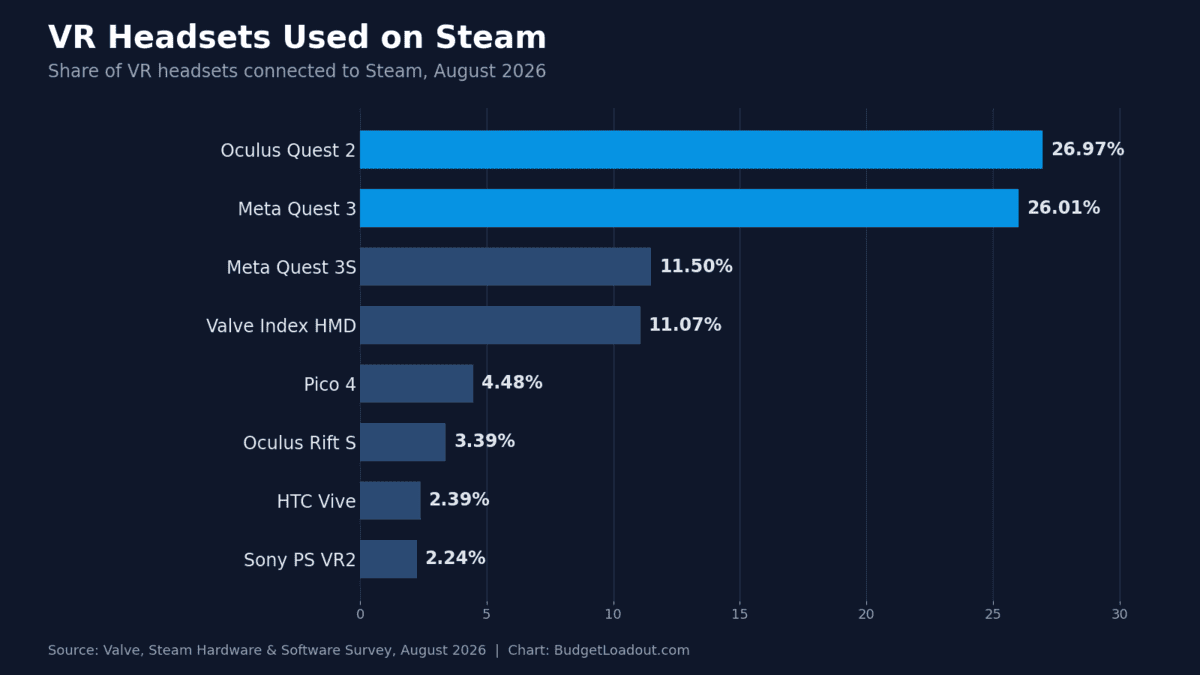
Meta’s three current and recent Quest models together account for about 64.48% of headsets used on Steam, by our tally. Sony’s PS VR2, which gained PC support through an adapter, is at 2.24%. Our best budget VR headset for PC guide covers the affordable options.
How Many Graphics Cards Ship Each Quarter?
12.5 million desktop graphics add-in boards shipped worldwide in the second quarter of 2026, up 10.0% from the previous quarter and up 6.6% from a year earlier, according to Jon Peddie Research, published September 9, 2026. The attach rate of graphics cards to desktop PCs rose to 89% in the same report.
Counting every PC graphics processor, including the ones built into processors and laptops, the market reached 75.5 million units in the same quarter, up 10.4% from the previous quarter and 1.1% from a year earlier, according to a second Jon Peddie Research report. Notebook graphics shipments rose 16.8% while desktop graphics fell 4%.
On the supplier side, AMD reported gaming revenue of $779 million for the second quarter of 2026, down 31% from a year earlier, which it attributed to lower semi-custom revenue, in its August 4, 2026 results. Semi-custom is the business that supplies console chips.
How Many Americans Play Video Games?
212.3 million Americans play video games every week, which is 67% of Americans aged 5 to 90, according to the Entertainment Software Association’s 2026 Essential Facts report released June 3, 2026. That is 7.2 million more than in 2025.
The average player is 37 years old. 53% of men and 46% of women play. More than 80% of Gen Alpha and Gen Z play weekly, along with 71% of Millennials, 56% of Gen X and 50% of Boomers. Mobile is the most-used platform at 80% of players, and the ESA notes that PC and console play is more common among younger generations.
How Much Do Americans Spend on Gaming Hardware?
Americans spent $60.7 billion on video games in 2025. Of that, $52.3 billion went to content, $5.4 billion to hardware, and $2.95 billion to accessories, according to the ESA’s 2026 Essential Facts data.
Accessories are a $2.95 billion category in the US. The mouse, keyboard and headset market is not a rounding error.
What the Average Means for Your Next Upgrade
Averages describe what people already own, not what they should buy next. A new part has to last several years, so matching today’s typical PC is the floor for an upgrade, not the target. Here is how the numbers translate, part by part.
Graphics Card
The typical card is a 60-class model, and that tier still handles 1080p well. With 8GB and 16GB almost tied as the most common amounts of video memory, 8GB is now the minimum for a new card rather than the comfortable choice. Our best budget graphics card guide covers the 1080p route, and a 70-class card only earns its place if you are also moving to 1440p.
System Memory
16GB is still the most common amount, but 32GB is closing in every month. For a new build, 32GB keeps you ahead of where the average is heading. Whether that memory is DDR4 or DDR5 depends on the platform, which our best AM5 motherboard guide covers for newer AMD builds.
Processor
Six and eight cores cover most surveyed PCs, and games run well on either. Going past eight cores helps streaming and heavy multitasking more than frame rates. If you are on an older AMD board, our best AM4 CPU guide covers drop-in upgrades that reach eight cores without a new platform.
Monitor
Half of Steam users are on 1080p, and it remains the resolution where a typical card runs smoothly at high refresh rates. A 144Hz monitor at 1080p is the least demanding way to make an average PC feel faster. Moving to 1440p is the clearest trend in the survey, but it asks more of the graphics card, so plan the two upgrades together.
Storage
Capacity is rarely the problem, free space is. With 16.80% of surveyed PCs under 100GB free, a second SSD is often the most useful upgrade on this list. Our 512GB vs 1TB vs 2TB SSD comparison helps pick the size.
When to Replace the Whole PC
If three or more rows of the table above sit in the below-typical column, a new machine usually beats piecemeal upgrades. Our best gaming PC under 1000 and gaming PC under 500 guides cover complete builds at both ends of the budget.
How This Page Is Sourced and Updated
Every figure on this page comes from the organization that produced it: Valve for Steam hardware data, the Entertainment Software Association for US player and spending data, Jon Peddie Research for shipments, and AMD’s own financial results. Each figure was checked on the source page on September 21, 2026. Where a number is described as our tally, it is a sum of figures from the linked source and not a number the source published itself.
The Steam survey has limits worth knowing, and they apply to every figure in these average gaming PC specs. It is an opt-in sample of computers running Steam, so it describes Steam users, not every PC and not the sales market. It counts installed hardware, which is why older cards rank so high. The shipment figures from Jon Peddie Research describe what was sold in a quarter, which is a different question.
This page is refreshed each month after Valve publishes new survey results, and the other sources are updated when new editions appear. You are welcome to cite any figure here. Please link to this page or to the original source.
Frequently Asked Questions
Short answers to the questions people ask most about average gaming PC specs.
What are the average gaming PC specs in 2026?
The most common gaming PC on Steam in August 2026 runs Windows 11 (70.97% of surveyed PCs) with 16GB of memory (41.20%), an 8-core processor (28.04%), an NVIDIA GeForce RTX 3060 (3.76%) and a 1920 x 1080 display (50.52%), according to Valve’s Steam Hardware and Software Survey.
What is the most popular graphics card on Steam?
The NVIDIA GeForce RTX 3060, at 3.76% of surveyed Steam PCs in August 2026. The RTX 4060 Laptop GPU is second at 3.63% and the RTX 5070 is third at 3.56%.
How much RAM do most gamers have?
16GB is the most common amount at 41.20% of surveyed Steam PCs, followed by 32GB at 37.45%. Only 7.46% still have 8GB, according to Valve’s August 2026 survey.
What resolution do most PC gamers use?
1920 x 1080. 50.52% of Steam users have a 1080p primary display, 21.86% use 2560 x 1440, and 4.98% use 4K, according to Valve’s August 2026 survey.
Is the Steam Hardware Survey accurate?
It is the largest regular snapshot of gaming PC hardware available, but it is an opt-in sample of computers that run Steam. It describes Steam users and installed hardware, not every PC and not quarterly sales, so it should not be read as market share.
Looking for more budget gaming gear? Check out Budget Loadout for the latest reviews and recommendations.
Related Articles