You’re probably looking at the same question most budget-minded gamers hit sooner or later. Buy a console now, plug it into the TV, and be done with it. Or spend more effort on a gaming PC that might pay you back over time.
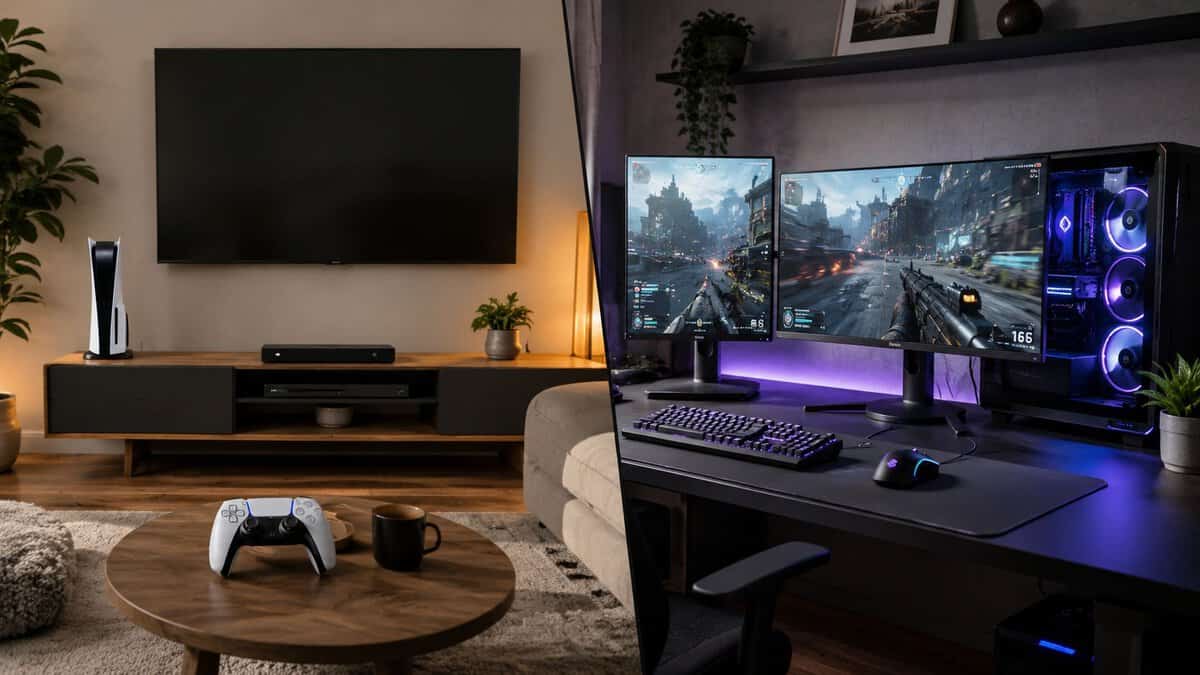
That choice used to be simpler. Consoles were the obvious value pick up front, and PCs were the expensive enthusiast option. In 2026, that framing misses what matters. The better buy isn’t the one with the lower sticker price. It’s the one that costs you less frustration, less forced spending, and fewer dead-end upgrades over the next five years.
A lot of console vs PC gaming advice still gets stuck on launch pricing and spec sheets. Real ownership looks different. You have online fees to think about, game pricing habits, whether you play mostly new releases or older titles, whether you care about high refresh rates, and whether you’ll use a system for more than games. New rendering tech also changes the math. AI upscaling and frame generation don’t make every budget PC a miracle box, but they do make modest hardware stay relevant longer than older comparisons suggest.
That matters most for players who aren’t chasing bragging rights. If you play competitive FPS games, MMOs, story-driven games, and maybe stream a little on the side, the right answer depends less on marketing and more on use case. Build quality, thermal behavior, upgrade path, controller comfort, peripheral durability, and library value all matter more than a flashy spec headline.
- Consoles win on upfront cost and plug-and-play simplicity; PCs win on long-term flexibility and value
- Over five years, free online play, deeper game sales, and part-by-part upgrades narrow the PC’s cost gap
- Choose PC for high-refresh esports, modding, and the biggest game library; choose console for couch play and zero maintenance
- Most big games launch on both platforms, so exclusives and back catalog are the real differentiators
- Match the platform to how you actually play, not just to the lower sticker price
Table of Contents
The Real Choice in 2026
The honest split is this. Console is usually the easier purchase. PC is often the better long-term system. Those aren’t the same thing.
For a lot of people, the console pitch is still strong. It’s compact, simple, predictable, and built around a locked hardware target. You don’t spend your first weekend checking settings, updating drivers, or wondering if a cheap power supply was a mistake. For a living room setup, that convenience still counts.
PC earns its case differently. It gives you more control over performance targets, more flexibility with peripherals, and a much broader range of ways to save money over time. It also handles mixed use better. If the same machine needs to cover gaming, school, work, voice chat, recording, and streaming, a PC starts pulling ahead fast.
What actually changes the decision
Old console vs PC gaming arguments often ignore the habits that drive total value:
How long you keep hardware: A fixed console generation is easy to understand, but a PC can stay relevant longer if the core parts are solid and you only upgrade one weak link later.
What kinds of games you play: Competitive shooters reward higher frame rates and lower latency. MMOs and strategy games usually feel more at home on PC. Couch co-op and casual family play still favor consoles.
How you buy games: If you mostly buy new releases on launch day, the savings gap narrows. If you live in sales and back catalogs, PC gets stronger.
Whether you care about tuning settings: Some players want one graphics mode and one performance mode. Others want control over every setting that affects frame pacing, visuals, and thermals.
Practical rule: If you want your system to stay exactly the same for years and you hate troubleshooting, a console fits better. If you’re comfortable making one smart upgrade later, PC usually gives you more ways to stretch your money.
The most useful way to decide isn’t “which one is more powerful.” It’s “which one wastes less of my money over the life of the system.”
Upfront vs Long-Term Cost: A 5-Year Breakdown
The sticker price is where most bad buying advice starts. It’s visible, easy to compare, and incomplete.
A console usually wins the opening round because the box gets you into current-generation gaming with less hassle. A budget gaming PC asks for more thought. You need a balanced CPU and GPU, enough storage, decent cooling, and a power supply that won’t become the weakest part of the build. Build quality matters here. Cheap cases, weak thermals, and bargain-bin motherboards often turn a “budget” PC into a short-lived one.
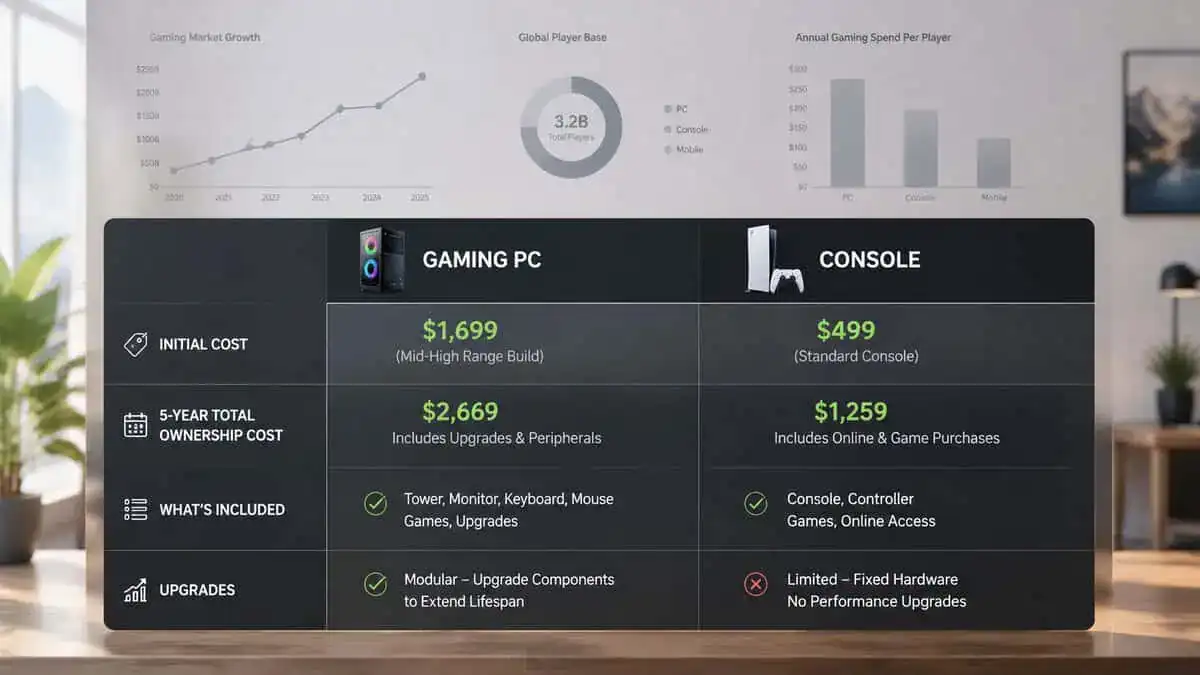
5-Year Total Cost of Ownership Estimate 2026
| Cost Item | Console (PS5/Xbox Series X) | Budget Gaming PC |
|---|---|---|
| Initial hardware | Lower upfront buy-in | Higher upfront buy-in |
| Online multiplayer | Usually requires paid subscription for full online features | Often free for standard online multiplayer |
| Game pricing over time | New releases often stay expensive longer | Sales, bundles, and older catalog discounts are usually better |
| Mid-cycle upgrade | Usually none, but no performance path beyond the box | One targeted upgrade can extend life significantly |
| Storage expansion | Often simple, but branded or spec-limited options can cost more than expected | Broad storage options with more flexibility |
| Non-gaming use | Limited compared with a PC | Covers gaming, work, school, streaming, and general use |
| 5-year value pattern | Better if you want fixed costs and minimal tinkering | Better if you’ll use sales, skip subscription costs, and upgrade once intelligently |
The hard part is that a five-year model depends on your habits. There isn’t a universal number that fits everyone, and pretending otherwise is how people overspend. What does hold up is the shape of the spending.
Where the money usually goes
Console ownership tends to look cleaner at first and more restrictive later.
Online access: If you play multiplayer regularly, subscription fees become part of the platform cost, not an optional extra.
Game pricing: Console storefronts do run discounts, but budget buyers often find stronger long-tail value on PC.
Storage and accessories: Extra space, another controller, or a premium headset can close part of the “cheap console” gap quickly.
PC ownership is more uneven, but it gives you more control.
Front-loaded spending: You pay more at the start if you want a machine with decent airflow, durable parts, and a realistic upgrade path.
Lower forced platform fees: That matters over years, especially if you mainly play online.
Selective upgrades: Replacing one part is very different from replacing the whole platform.
Independent market research summarized by Slashdot says PC gaming generated about $45.8 billion in consumer spending in 2024, making it the largest segment of the games industry, which lines up with the idea that many players stay in the ecosystem for long-term value rather than just low entry cost (Slashdot summary of Epyllion’s 2024 PC gaming estimate).
Don’t cheap out on storage if you go the PC route. Load times, patch management, and day-to-day responsiveness all suffer when the drive is the bottleneck. A practical refresher on SSD vs HDD for gaming helps if you’re deciding where to trim and where not to.
If you only want the lowest immediate entry cost and don’t care about subscriptions or flexibility, console still makes sense. If you want the better ownership curve, PC has the stronger argument.
Performance, Graphics and Future-Proofing
Most marketing still pushes resolution first. In actual play, frame rate, frame pacing, and responsiveness matter more.
Consoles have a real strength here. Developers target one fixed hardware profile, so games are built around known limits. That gives you a reliable experience with less setup. You turn it on, choose the quality or performance mode, and play. For many players, that stability is worth more than raw headroom.
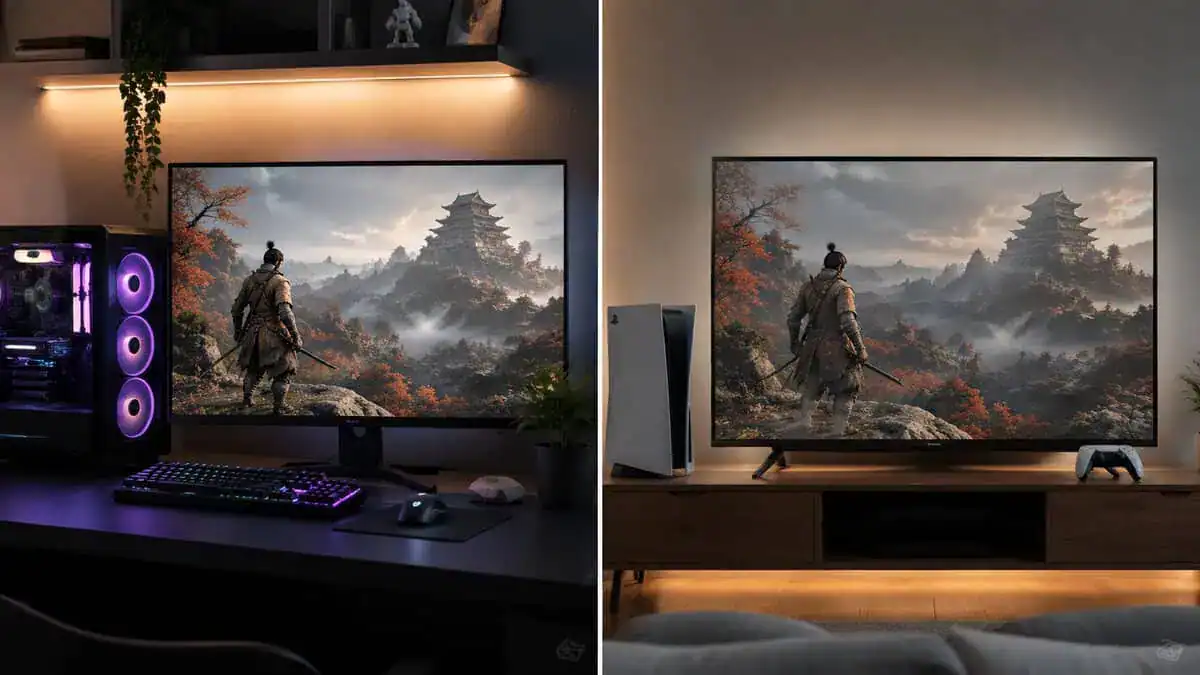
Why high refresh still matters
For competitive and fast-action games, PC keeps the clear lead. According to Seagate’s console vs PC gaming overview, modern consoles often cap at 60 fps because of CPU constraints, with 120Hz modes available in select titles, while mid-range gaming PCs can comfortably run at 120 to 144 FPS at 1080p. The same source notes that high-end PCs can go further, and that newer PC-only rendering features such as multi-frame generation can push performance beyond what consoles currently offer.
That’s not just a spec-sheet win. In shooters, racing games, and fighting games, higher frame rates make motion easier to track and input feel cleaner. You notice it every second you play.
Where AI upscaling changes the value equation
AI upscaling is the biggest reason older PC advice needs updating.
A few years ago, a budget build that fell behind often stayed behind. Now, if you choose a sensible GPU tier and keep your expectations realistic, upscaling and frame generation can extend a build’s useful life. They don’t fix a weak CPU, poor cooling, bad memory configuration, or a low-quality power supply. They also don’t guarantee equal results in every game. But they can make a moderate PC feel current for longer.
That’s the key point for value-focused buyers. A budget PC doesn’t need to beat a console in every scenario to be the better five-year purchase. It needs to stay good enough, for long enough, while giving you more control over settings and upgrade timing.
Builder’s advice: Spend for balance, not for a headline part. A durable case, solid cooling, and a dependable power supply usually age better than overspending on one flashy component.
If you’re weighing graphics cards, the practical trade-offs around features, software support, and value shift by budget tier. A grounded breakdown of AMD vs Nvidia GPU options is worth checking before you lock a build.
Future-proofing is where console and PC really separate. Console gives you fixed performance and fixed limits. PC gives you a ceiling that can move with one upgrade. If you’re willing to learn enough to keep the system healthy, that flexibility is worth real money over time.
Game Libraries Exclusives and Modding
Your platform choice is also a library choice. That sounds obvious, but buyers still underrate it.
If you mostly play a handful of big annual releases and whatever your friends are already on, console libraries are easy to live with. If you jump between MMOs, older RPGs, strategy games, community servers, indie games, and heavily replayable titles, PC gets stronger every year you keep using it.
The back catalog matters more than new releases
The strongest PC advantage isn’t just exclusives. It’s access and longevity.
According to Plarium’s summary of 2024 PC gaming statistics, 80% of developers said they were making games for PC in 2024, up from 66% the year before. The same summary says roughly 67% of PC playtime in 2024 went to games over six years old, while only 8% went to new releases. That tells you something important about value. PC players don’t just buy hardware for this month’s launch calendar. They keep returning to older games that still run, still get community support, and still go on sale.
That’s a practical edge for budget buyers. A system with a strong back catalog wastes less money than one built around constant full-price purchases.
Modding changes how long games stay useful
Mods are one of the few advantages that still don’t translate cleanly to console.
A good mod scene can fix rough UI, improve visuals, rebalance gameplay, add quality-of-life features, and keep a favorite game alive long after official support slows down. For MMO players, strategy players, and sandbox fans, that can be the difference between a game you drop after one campaign and one you keep installed for years.
A few library trade-offs are worth stating plainly:
Console works better for curated simplicity: You get a cleaner storefront, fewer compatibility questions, and a more controlled user experience.
PC works better for breadth: Older games, niche genres, user-created content, and community patches all stack in its favor.
Exclusives still matter: If one specific series is the reason you play, that can override every value argument.
A platform with a cheaper habit is often better than a platform with a cheaper box. Players who rotate through older games, mods, and discount libraries usually feel that on PC.
If you’re also considering a handheld route instead of a desk or TV-first setup, this comparison of Nintendo Switch vs Steam Deck helps frame the same library and flexibility trade-offs in portable form.
Controls, Peripherals and Customization
This part gets dismissed too often. It shouldn’t. Controls and peripherals shape how a game feels every minute you’re using it.
Console keeps things simple. One controller standard, one couch-friendly layout, and usually less friction when you just want to play from a distance. For third-person action games, sports games, platformers, and casual co-op, that’s still a great fit. A good controller is durable, familiar, and easy to hand to someone else.
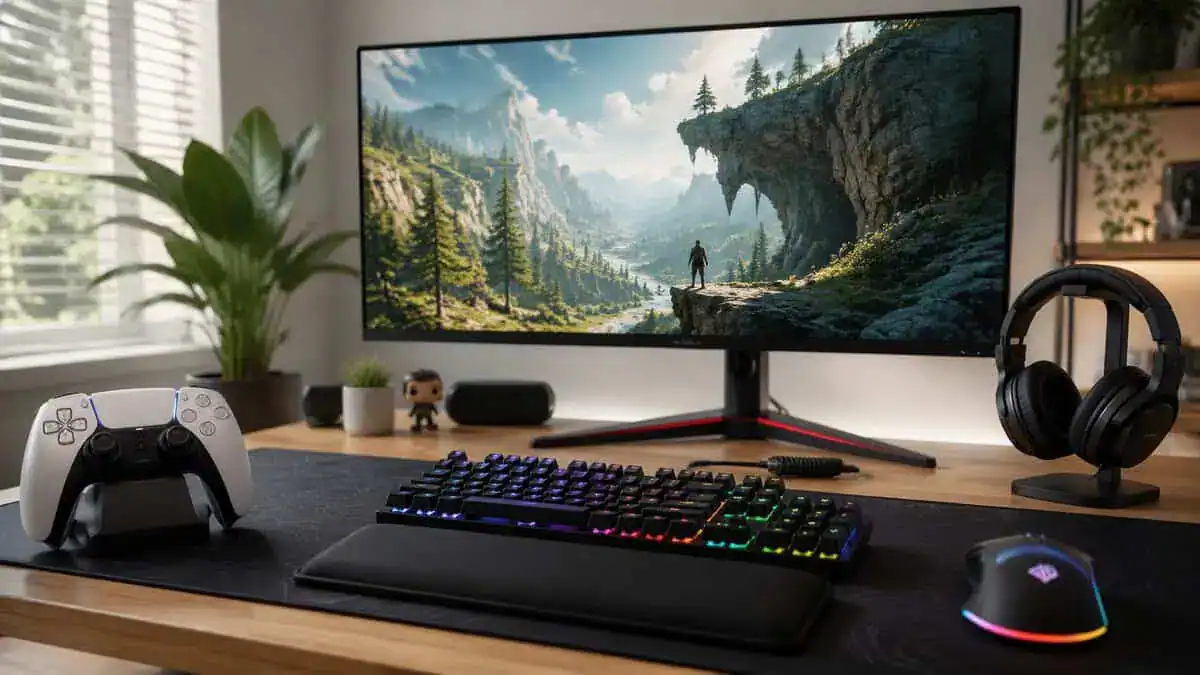
Which input makes sense for which genre
Mouse and keyboard aren’t automatically better. They’re better for specific jobs.
FPS games: Mouse aiming still gives the cleanest precision and fastest target correction.
MMOs and strategy: Extra keys, macros, and UI control make PC the natural fit.
Racing and flight: Both platforms can work, but PC usually gives you more wheel, pedal, and stick options.
Story games and platformers: Many players still prefer a controller, even on PC.
That flexibility is where PC earns its keep. You can play with mouse and keyboard, switch to controller for another game, or mix specialized gear depending on what you play.
The accessory market is wider on PC
The open PC ecosystem gives buyers more room to find value. You’re not pushed as hard toward platform-locked accessories, and you have more freedom to replace one worn-out part instead of rebuying a branded bundle.
Build quality matters a lot here. A cheap keyboard with weak switches, a mouse with side-button wobble, or a headset with brittle hinges stops being a bargain fast. The same goes for console accessories. If a controller develops stick issues early or a licensed headset has flimsy plastic, the low initial price won’t matter.
Here’s the practical difference:
Console buyers get consistency. That’s good if you don’t want to research much.
PC buyers get choice. That’s good if you care about comfort, repairability, and matching gear to the games you play.
Hybrid players get the most flexibility on PC. You can still use a controller, but you’re not limited to it.
If your play style changes often, PC gives you more room to adapt without replacing the whole setup.
Multiplayer Streaming and Social Features
Console social features are cleaner out of the box. That’s the main reason many people stay there.
Friend lists, invites, party chat, and clip sharing are all built into the platform experience. For players who mostly log in to play with the same group, that consistency matters. You spend less time managing accounts and less time explaining where to join voice chat.
PC is less tidy, but more capable. You’ll often mix a game launcher, a separate voice app, and your own recording or streaming setup. That can feel messy at first. Once it’s dialed in, though, it’s far more flexible.
Competitive play and responsiveness
For multiplayer, responsiveness matters as much as social convenience. A direct comparison video found that a PC setup had roughly 20 ms lower ping than the console setup on the same network, along with noticeably higher input delay on console, and the creator concluded that input delay was the biggest factor affecting responsiveness (direct PC vs console latency comparison on YouTube).
That lines up with what competitive players usually feel in practice. If you play ranked FPS games or fighters, PC paired with a high-refresh display tends to feel sharper and more immediate.
If your main goal is climbing in competitive games, lower latency and cleaner input response matter more than a polished console dashboard.
Streaming is easier on console and better on PC
Console wins on simplicity. Tap share, save a clip, start a basic stream. If that’s all you want, it does the job.
PC is better for anyone who wants control. You can build scenes, layer alerts, tune audio, manage multiple sources, and record cleaner local footage without shaping your whole workflow around console limitations. It also handles the rest of the content pipeline better. If you’re starting from scratch, this guide on how to start streaming on Twitch is a useful baseline for getting your setup right without overspending.
If you plan to turn streams into videos, upload timing matters almost as much as the edit itself. A practical guide to the best YouTube upload strategy 2026 can help if you want your clips and VOD-based content to perform better after you publish them.
The social trade-off is simple. Console gives you a more unified default experience. PC gives you a better toolkit once you’re ready to build your own workflow.
Final Verdict and Recommended Setups
There isn’t one winner for everyone. There is a better fit for the way you play.
If you want a machine that sits under a TV, starts fast, stays consistent, and doesn’t ask you to learn anything beyond basic setup, buy a console. If you want one system that handles gaming, high-refresh competitive play, MMOs, school or work tasks, mods, voice chat, and streaming without boxing you into one ecosystem, buy a PC.
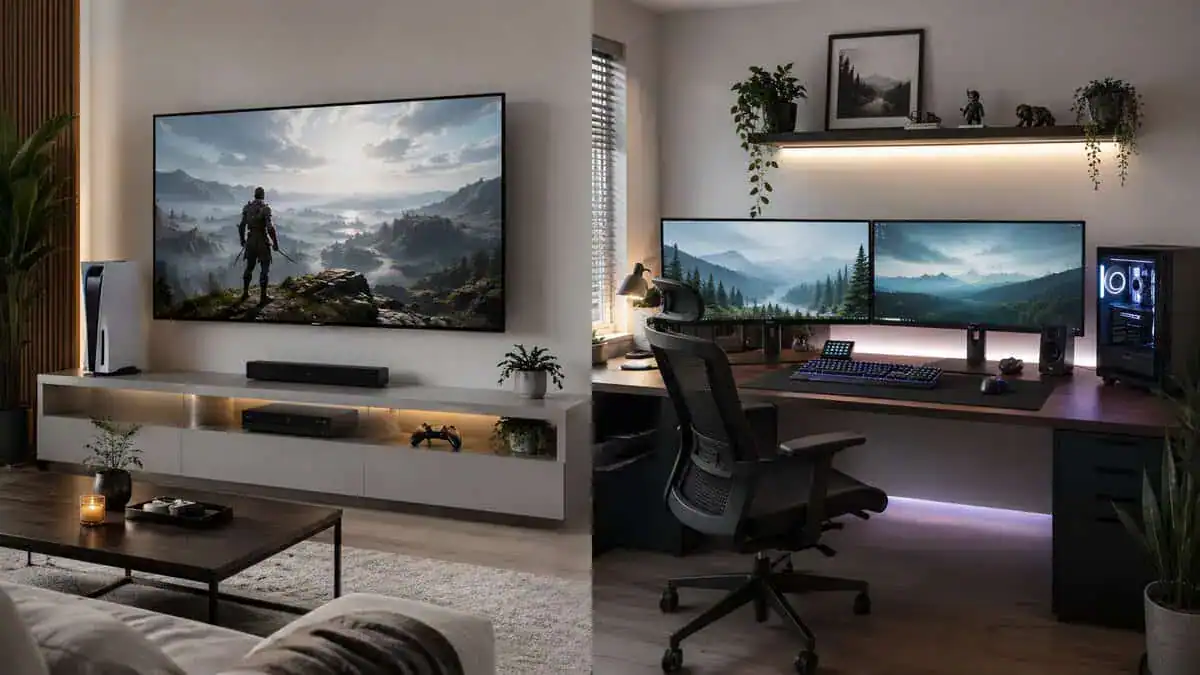
Buy a console if this sounds like you
A console is the better value when convenience is your top priority.
You want plug-and-play: No part picking, no driver issues, no tuning.
You play from the couch: A TV-first setup is still where consoles feel most natural.
You mostly play a few major releases: The broader PC catalog matters less if your habits are narrow.
You don’t want mid-cycle hardware decisions: One box, one platform, one standard.
Between the two main home-console paths, the value answer depends on whether you want access to a broad rotating library or you care more about specific first-party games. The better purchase is the one that matches your actual habits, not the one with the louder online fan base.
Build a PC if this sounds like you
A budget-conscious PC makes more sense when you care about ownership flexibility.
Look for a balanced build around an AMD Ryzen 5 class processor and an NVIDIA RTX 4060 class graphics card, backed by solid airflow, dependable cooling, and a power supply you won’t regret later. That kind of system isn’t about chasing extreme specs. It’s about getting stable 1080p performance, a realistic upgrade path, and enough headroom for streaming, MMO multitasking, and competitive games.
For buyers trying to stay sensible, a curated guide to the best gaming PC under $1000 is a practical starting point. Focus on the whole build, not just the GPU. A durable case, good thermals, and reliable storage make the system last.
Bottom line: Console is the easier value. PC is the broader value.
The best console vs PC gaming answer in 2026 comes down to one question. Do you want the cheapest path into current games, or the system that gives you more control over what you spend, how you play, and how long the setup stays useful? If you’re thinking five years ahead instead of five weeks, PC usually wins. If you want zero friction and a predictable experience tonight, console still earns its place.
Frequently Asked Questions
Still weighing console versus PC gaming? These are the questions budget-minded gamers ask most before they commit.
Is PC gaming more expensive than console gaming?
Upfront, yes — a capable gaming PC costs more than a console. But over a five-year window the gap narrows. PC players benefit from free online multiplayer, deeper game sales, and the option to upgrade one part at a time instead of replacing the whole system. Consoles win on simplicity and a lower buy-in; PCs win on long-term cost control.
Is console or PC better for competitive gaming?
PC has the edge for high-refresh esports titles — higher frame rates, mouse-and-keyboard precision, and lower input latency all matter when reactions count. Consoles are perfectly capable for casual competitive play and couch sessions, and a fixed hardware spec keeps matchmaking on an even playing field.
Can you play the same games on console and PC?
Most major multiplatform releases launch on both, so the big yearly titles are covered either way. The difference is at the edges: consoles lock in first-party exclusives, while PC adds the largest back catalog, frequent storefront sales, and mod support that keeps older games fresh for years.
Do you have to pay for online multiplayer on PC?
No — standard online play is usually free on PC. Consoles typically require a paid membership, such as PlayStation Plus or the Xbox equivalent, to unlock full online multiplayer, which adds a recurring cost that is easy to overlook when comparing the two.
Is a gaming PC worth it in 2026?
If you value high frame rates, modding, the broadest game library, and the ability to upgrade over time, a PC is worth the higher starting price. If you would rather plug into the TV and play with zero setup or maintenance, a console delivers strong value with far less hassle. The right answer depends on how you actually play.
If you’re building a value-focused setup and want honest advice on peripherals, streaming gear, and practical upgrades, Budget Loadout is a good place to start. It’s built for gamers who care about durability, comfort, and real performance per dollar, not hype.
Related Articles