The case is rarely the expensive part of a mini-ITX build. A mini-ITX case sets the rules for everything else in the box: which graphics card fits, which cooler clears the panel and whether a standard power supply goes in at all. Pick well and a small gaming PC avoids most of the extra parts; pick badly and you end up buying a smaller version of every part.
The four cases below suit budget builders, and each one asks something different of your parts. After the cards, the guide adds up the hidden costs of going small and shows which case dodges each one.
The safest small case for a first build. It takes a triple-slot graphics card and a tall tower air cooler at the same time, with no riser cable to buy.
- Fits a triple-slot card without a riser
- Takes a 155 mm tower air cooler
- Tool-free panels for easy access
- Needs an SFX or SFX-L power supply
- Only two fans in the box
- Vertical GPU mount cuts cooler room
A budget way into a mini-ITX build, and it reuses a standard ATX power supply. The trade is a short dual-slot card and a low-profile cooler.
- Reuses a standard ATX power supply
- Smallest case here at 11.5 L
- Mesh front panel for intake
- Dual-slot cards up to 270 mm only
- Coolers limited to 61 mm tall
- No fans included
A mini-ITX board with full-size everything else. A standard ATX power supply, a tall air cooler and a 360 mm radiator all fit in this tall showcase tower.
- Fits an ATX power supply
- Takes a 210 mm tower air cooler
- Two 120 mm fans included
- Tall tower rather than a compact box
- Newer case with thin owner feedback
- Heaviest case here at 7.1 kg
Built around an AIO cooler, with a front 280 mm radiator mount, a PCIe 5.0 riser and two fans in the box. Air coolers are limited to 75 mm.
- PCIe 5.0 riser cable in the box
- Front mount for a 280 mm radiator
- Two F120Q fans included
- Air coolers limited to 75 mm tall
- Needs an SFX or SFX-L power supply
- No support for rear-connector boards
- Check three graphics card numbers, not one: length, thickness in slots and height including the power cable.
- A small case that takes a standard ATX power supply saves you buying a separate SFX unit.
- Cooler height decides whether a tower air cooler fits or you need a low-profile cooler or an AIO.
- Budget for the motherboard first, since mini-ITX boards rarely come cheap.
- Start from the parts you already own: the case that fits them is cheaper than the one that forces new ones.
Table of Contents
The Shortlist: Four Small Cases and What Each Asks of You
Each case on this shortlist trades something different: power supply type, graphics card room, cooler height or overall size. The spec table lines up the numbers that decide whether your parts fit, taken from each maker’s spec page.
| Case | Size | Board | Power Supply | Max GPU Length | Max GPU Thickness | Max CPU Cooler | Radiator | Fans Included |
|---|---|---|---|---|---|---|---|---|
| Cooler Master NR200 | 18.25 L | Mini-ITX, Mini-DTX | SFX, SFX-L (130 mm) | 330 mm | 60 mm (triple slot) | 155 mm | Up to 280 mm (side) | 1x 120 mm + 1x 92 mm |
| SilverStone SG13 | 11.5 L | Mini-ITX, Mini-DTX | ATX (150 mm max) | 270 mm | 2 slots | 61 mm | 120 or 140 mm (front) | None |
| Thermaltake The Tower 250 | 506 x 300 x 281 mm | Mini-ITX | ATX or SFX (200 mm) | 360 mm (power cover removed) | Not listed | 210 mm | Up to 360 mm (side) | 2x 120 mm |
| NZXT H2 Flow | 20.7 L | Mini-ITX | SFX, SFX-L (130 mm) | 331 mm | 65 mm | 75 mm | Up to 280 mm (front) | 2x 120 mm |
Cooler Master NR200
The Cooler Master NR200 is the mini-ITX case to start with if you want room for real gaming parts without a riser cable or an unusual layout. Inside 18.25 L, it holds a graphics card up to 330 mm long and 60 mm thick (triple slot) and a CPU air cooler up to 155 mm tall, and the card sits horizontally in the motherboard slot, just as it would in a tower.
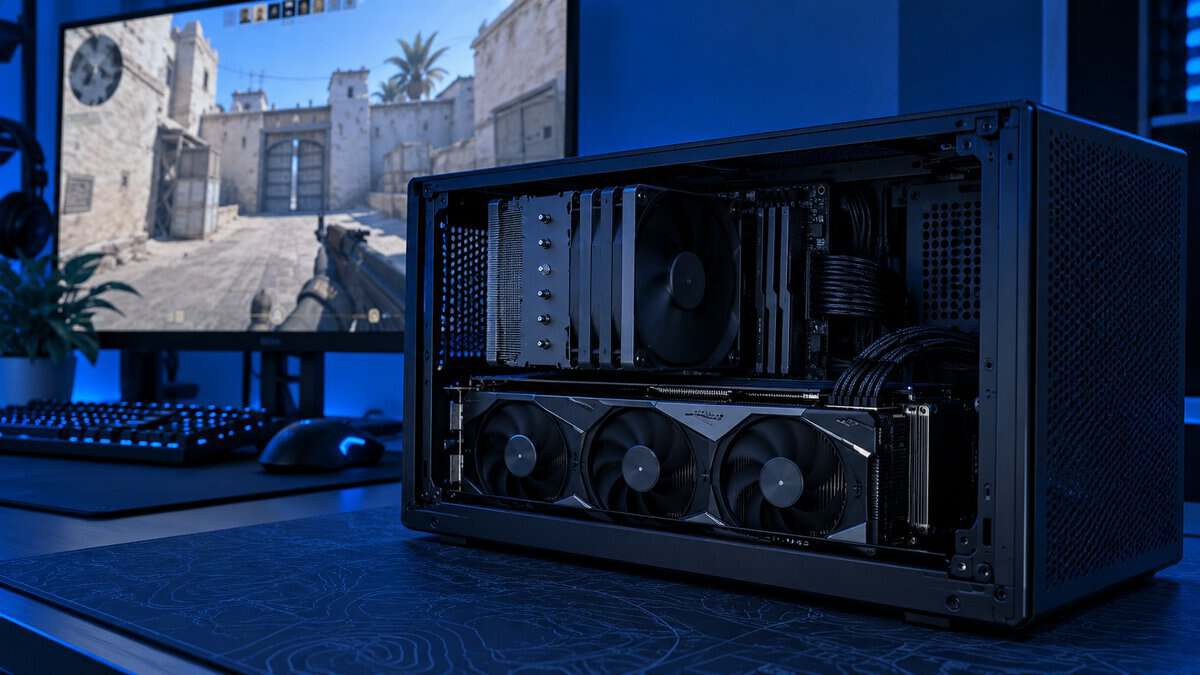
The NR200 fits a big card and a big cooler at the same time, without a riser.
Those two clearances together are why the NR200 suits budget builders: you can pick an ordinary model from our best budget CPU cooler guide as long as it stands 155 mm tall or less.
The panels come off without tools, the side takes a 240 mm or 280 mm radiator if you switch to liquid cooling later, and Cooler Master ships it with a 120 mm top fan and a 92 mm rear fan. The catch is power: the NR200 takes SFX or SFX-L units only, up to 130 mm long. Mounting the card vertically also drops cooler room to 76 mm and rules out the side radiator.
SilverStone SG13
The SilverStone SG13 is the budget pick, and its biggest saving is not on the case itself. It takes a standard ATX power supply up to 150 mm long (SilverStone recommends 140 mm), so an ATX unit from an old build, or a less expensive new one, goes straight in.
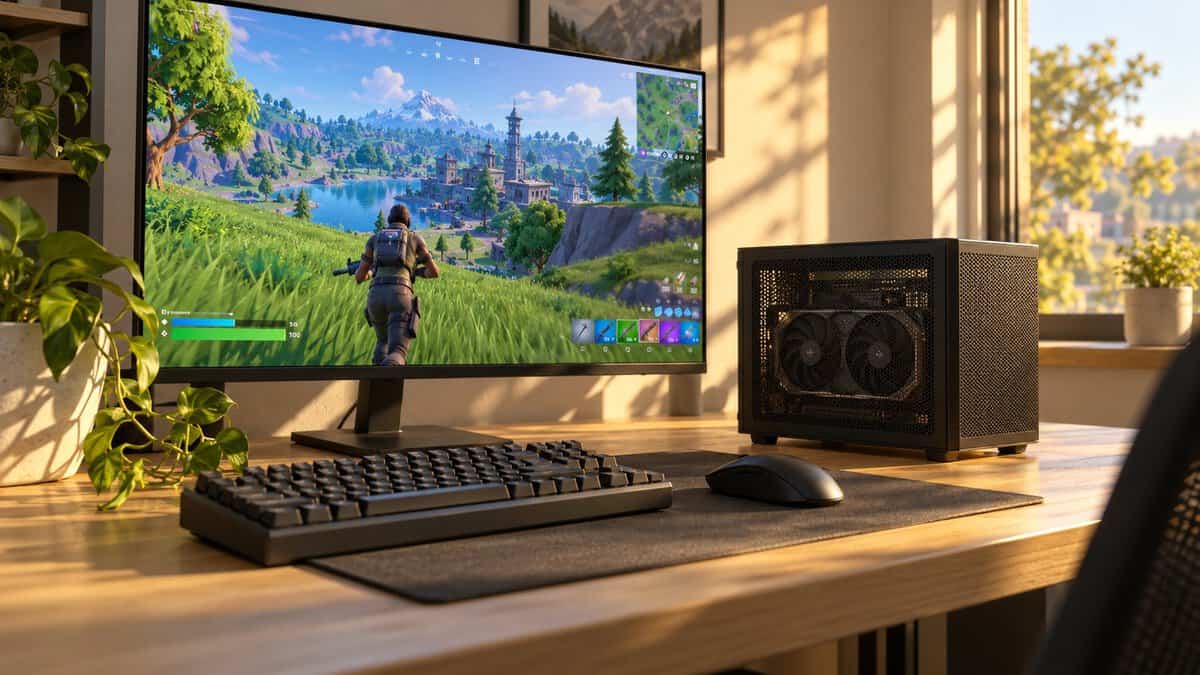
The SG13 keeps a small build cheap if your graphics card is short.
At 11.5 L (222 x 181 x 285 mm), the SG13 is the smallest case here, with a mesh front panel for intake. That size sets hard limits: graphics cards up to 270 mm long and 2 slots thick, and CPU coolers up to 61 mm tall, which means a low-profile cooler rather than a tower.
Cooling is basic. No fans come in the box, and the front takes one 120 mm or 140 mm fan or radiator. Fit a 140 mm radiator there and card room drops to 236 mm minus the radiator’s thickness, so the SG13 works best with a short dual-slot card and a low-profile air cooler.
Thermaltake The Tower 250
The Thermaltake The Tower 250 flips the usual small-build trade: only the motherboard has to be mini-ITX. It takes an ATX or SFX power supply up to 200 mm, a graphics card up to 360 mm with the power cover removed, and a CPU air cooler up to 210 mm tall.
The Tower 250 is for builders who want a mini-ITX board and nothing else miniature.
Liquid cooling has room too. The side mount takes a 360 mm or 280 mm radiator and two 120 mm CT120 fans come installed at the top. The front ports include a USB 3.2 Gen 2 Type-C port.
The trade is size. The Tower 250 stands 506 mm tall and weighs 7.1 kg, so it is a showcase tower that happens to use a mini-ITX board, not a box that tucks beside a monitor. It is also newer, so long-term owner feedback is still thin.
NZXT H2 Flow
The NZXT H2 Flow is the pick if you plan to cool the CPU with an AIO. NZXT builds the 20.7 L case around a front 280 mm radiator mount and includes a PCIe 5.0 riser cable and two F120Q fans at the top, so parts that often add cost to a small liquid-cooled build are already in the box.
The H2 Flow is the one case here designed around a liquid cooler.
Graphics card room is generous for the size: up to 331 mm long, 150 mm tall and 65 mm thick. Power comes from an SFX or SFX-L unit up to 130 mm, and the front panel adds a USB 3.2 Gen 2×2 Type-C port.
Air cooling is the weak spot. CPU coolers top out at 75 mm, which rules out tower coolers, and NZXT notes that the H2 Flow does not support motherboards with rear-mounted connectors.
The Mini-ITX Case Tax: Four Costs a Small Build Can Add
The mini-ITX case tax is the extra money a small build can cost beyond the case itself. It shows up in four places, and the right case dodges up to two of them.
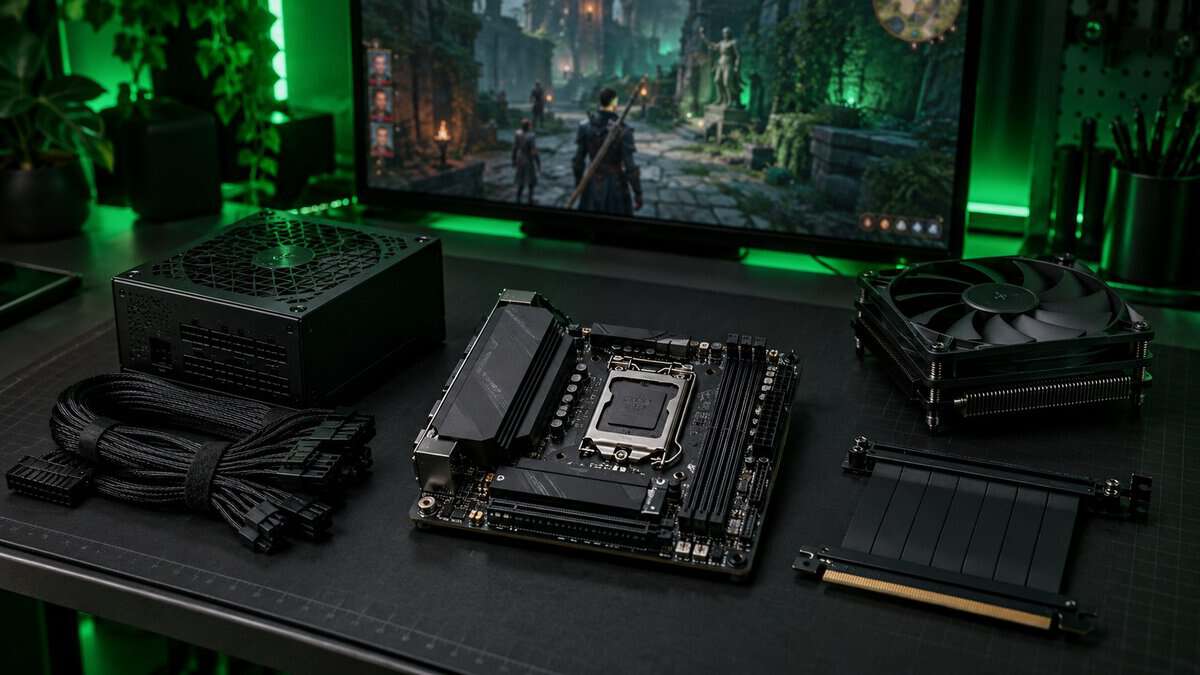
The Motherboard Premium
A mini-ITX motherboard tends to cost more than a micro-ATX board with a similar chipset. No case on this list avoids this cost: all four need a mini-ITX board, and the NR200 and SG13 also take Mini-DTX.
If you are building on AMD’s AM4 platform, our best AM4 motherboard guide walks through how ATX, micro-ATX and mini-ITX boards trade slots and expansion.
The SFX Power Supply
An SFX power supply is the compact power unit many small cases need, and it tends to cost more than an ATX unit of the same wattage. The NR200 and the H2 Flow both take SFX or SFX-L units up to 130 mm long.
The SG13 and the Tower 250 dodge this cost entirely, because both take a standard ATX unit. If your case does need one, our SFX PSU guide covers the sizes and what to look for.
The Riser Cable
A riser cable lets a case mount the graphics card away from the motherboard slot, and a good one bought separately adds real cost. The NR200 avoids it in its standard layout, where the card plugs straight into the board. The H2 Flow needs one but includes a PCIe 5.0 riser in the box, and the Fractal Design Mood ships with a PCIe 4.0 riser.
The Low-Profile Cooler
A low-profile cooler is the CPU cooler a short case forces on you. The SG13 (61 mm) and the H2 Flow (75 mm) both need one or an AIO, with a 120 or 140 mm radiator in the SG13 and up to 280 mm in the H2 Flow.
The NR200 (155 mm) and the Tower 250 (210 mm) dodge this cost, because both take a regular tower air cooler.
Graphics Card Fit Goes Beyond Length
Graphics card fit in a mini-ITX case depends on three numbers: length, thickness and height. Length is printed first, and it is the one least likely to catch you out.
Thickness and Height Are the Hidden Limits
Graphics card thickness, measured in slots or millimeters, decides whether a card clears the case’s expansion slots and the panel beside it. A card listed as 2.5 or 3 slots will not fit the SG13, which allows 2 slots, however short it is.
Card height runs from the motherboard slot to the card’s top edge, and in a small case it has to include the bend of the power cable plugged into the top. The NR200 lists 156 mm of height including the power connector, and the H2 Flow lists 150 mm. Measure your card against all three numbers before you buy.
The SFF-Ready Label on Cards and Cases
NVIDIA’s SFF-Ready label marks GeForce cards and cases sized for small builds. On its SFF-Ready Enthusiast GeForce Cards page, NVIDIA defines an SFF-Ready card as an RTX 70-class or higher model from the GeForce RTX 50 or RTX 40 Series with a maximum height of 151 mm including the power cable bend radius, a maximum length of 304 mm and a maximum depth of 50 mm or 2.5 slots.
The same page lists SFF-Ready cases from several makers, including the Fractal Design Mood. A case does not need the label for an SFF-Ready card to fit, though: the NR200’s 330 mm length, 156 mm height and 60 mm thickness all exceed those card limits. The H2 Flow is the one to measure carefully, since its 150 mm height limit sits 1 mm under the label’s maximum card height.
The SG13 goes the other way. Its 270 mm length, 129 mm card height and 2-slot limit are all below the label’s maximums, so an SFF-Ready card is not automatically an SG13 card.
Air or Liquid Cooling in a Small Box
Cooling a mini-ITX build comes down to two numbers on the case’s spec sheet: the CPU cooler height limit and the size and position of its radiator mount.
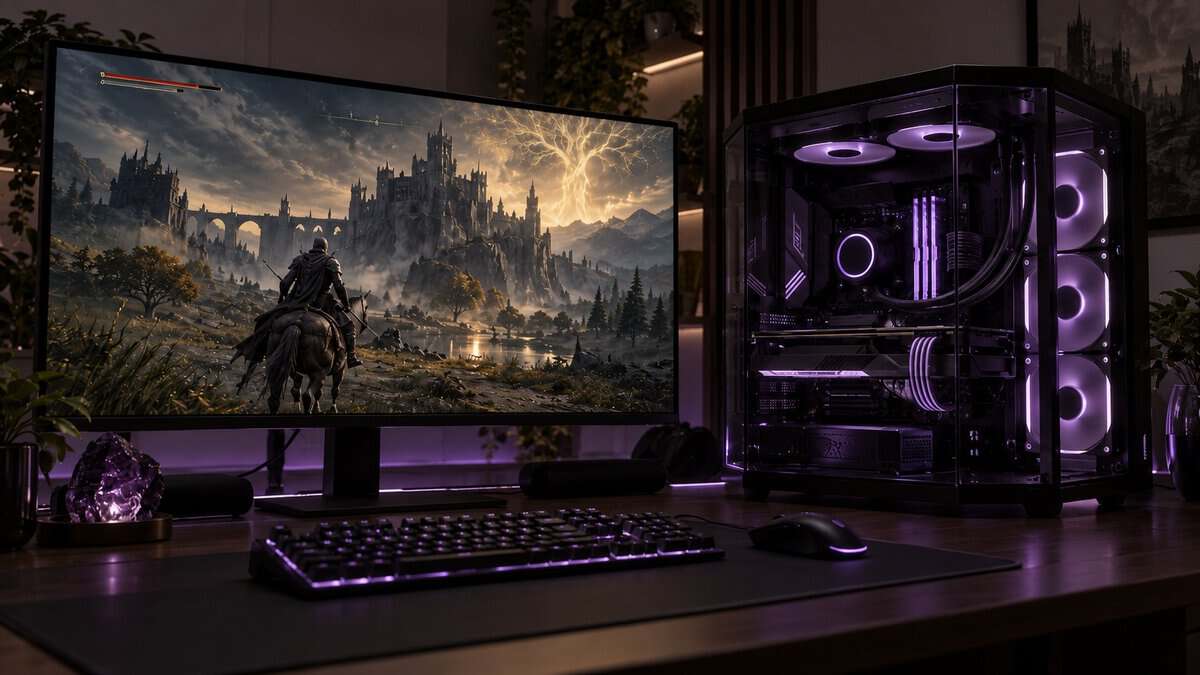
Where an Air Cooler Still Fits
An air cooler fits well in the NR200 and the Tower 250, which take tower coolers up to 155 mm and 210 mm. A tower cooler is often the less expensive route, with no pump to wear out.
In the SG13, an air cooler has to be a low-profile model 61 mm tall or shorter, which suits CPUs with modest heat output better than hot-running chips.
When a 240 mm or 280 mm AIO Earns Its Place
A 240 mm or 280 mm AIO earns its place when the case blocks tall air coolers but has a radiator mount. The H2 Flow is the clearest example: with a 75 mm cooler limit and a front 280 mm mount, an AIO is the practical way to cool a hotter CPU.
The NR200 takes a 240 or 280 mm radiator on its side, and the Tower 250 goes up to 360 mm on its side for the biggest liquid coolers. Our best AIO cooler guide covers 240 mm and 360 mm liquid coolers.
Two More Small Cases Worth Knowing
The Fractal Design Mood and the Cooler Master NR200P V3 suit two specific builds: a PC that lives in the living room and a graphics card longer than 330 mm.
Fractal Design Mood for the Living Room
The Fractal Design Mood is a fabric-wrapped pillar case for a mini-ITX build that lives next to a TV. It stands 453 mm tall on a 212 x 212 mm footprint (19.46 L) and cools with a single 180 mm top fan.
Inside, the Mood takes a graphics card up to 325 mm long and 56 mm thick, with a PCIe 4.0 riser included, a CPU cooler up to 114 mm and an SFX or SFX-L power supply.
Cooler Master NR200P V3 for Bigger Cards
The Cooler Master NR200P V3 is the newer member of the NR200 family, and its listing gives room for graphics cards up to 361.5 mm long, more than the original NR200’s 330 mm.
If your card is longer than 330 mm, the NR200P V3 is the one to look at; check its cooler and power supply limits against your parts before you buy.
Mini-ITX or Micro-ATX for a Budget Gaming PC
Mini-ITX and micro-ATX are both smaller than full ATX, and for a budget gaming PC the choice mostly comes down to how small the finished machine needs to be. Professor Messer’s motherboard form factors lesson explains the ATX and ITX families and notes that a Mini-ITX board can suit a small form factor computer kept next to a television.
A micro-ATX board has room for more expansion slots and often four memory slots, where a mini-ITX board has one expansion slot and usually two memory slots. Micro-ATX cases also leave more room for cable routing.
A mini-ITX build makes sense when the size is the point: a PC on the desk, under a TV or on a shelf. If it is not, our micro-ATX case guide covers compact cases with more room for a budget build.
Start From the Parts You Already Own
A mini-ITX case that fits the parts you already own costs less than one that forces new ones, so start with what is already on your desk.
| If You Already Own | Case | Why It Fits | Watch For |
|---|---|---|---|
| A big triple-slot card and a tower air cooler you want to keep | Cooler Master NR200 | 330 mm by 60 mm card room and 155 mm cooler height together | Needs an SFX or SFX-L power supply |
| A standard ATX power supply and a short dual-slot card | SilverStone SG13 | Reuses the ATX unit up to 150 mm | 270 mm card limit and a 61 mm cooler |
| Full-size everything: ATX power supply, big air cooler or 360 mm AIO | Thermaltake The Tower 250 | Only the board has to be mini-ITX | A tall tower, not a compact box |
| An AIO cooler, or a plan to buy one | NZXT H2 Flow | Front 280 mm radiator mount and a PCIe 5.0 riser in the box | 75 mm limit for air coolers |
If you own nothing yet, the NR200 is the most forgiving starting point: it fits a triple-slot card and a tower cooler, and only the power supply has to be SFX or SFX-L.
Frequently Asked Questions
Quick answers about choosing a mini-ITX case.
Do I need an SFX power supply for a mini-ITX case?
Not always. Many mini-ITX cases, including the Cooler Master NR200 and NZXT H2 Flow, need an SFX or SFX-L unit. The SilverStone SG13 takes a standard ATX power supply up to 150 mm, and the Thermaltake The Tower 250 takes ATX or SFX units up to 200 mm.
Can a mini-ITX case fit a full-size graphics card?
Yes, many can. The NR200 takes cards up to 330 mm long and triple-slot thick, the H2 Flow up to 331 mm, and the Tower 250 up to 360 mm with its power cover removed. Check the card’s height and thickness too.
Is a mini-ITX build harder for a first PC?
It can be. Tight space makes cable routing and cooler installation fiddlier than in a tower. A conventional layout with tool-free panels, like the NR200, or a roomier case like the Tower 250, makes it easier.
Does a mini-ITX case run hotter?
It can. A small case holds less air, so fan placement and part choice matter more than in a tower. The NR200, H2 Flow and Tower 250 each include two fans and take a radiator, which helps keep temperatures under control with a capable cooler.
Mini-ITX or a mini PC for gaming?
A mini-ITX build takes a full desktop graphics card and lets you upgrade parts later. A mini PC is smaller and ready to use, but it usually relies on integrated graphics or mobile chips that cannot be swapped.
Looking for more budget gaming gear? Check out Budget Loadout for the latest reviews and recommendations.
Related Articles