Everyone keeps saying Hall effect keyboards are the obvious upgrade. That advice is too simple, and the real hall effect vs mechanical keyboard answer depends on how you actually play. If you mainly play competitive FPS and live on counter-strafes, sure, Hall effect can earn its keep. If you type all day, play MMOs, stream, or just want the smartest value for your money, mechanical still makes a lot of sense.

- Hall effect wins when rapid trigger and adjustable actuation genuinely change how you play competitive FPS titles
- Mechanical keyboards stay the value default, with a far wider spread of switches, layouts, and mod options
- Latency gaps are small on paper; consistency in repeated movement is where magnetic switches actually earn their keep
- Typists, MMO players, and mixed-use desks usually get more from a good mechanical board than from magnetic features they will not use
- Pick the switch technology that matches how you play first, then choose the board tier that fits your budget
Table of Contents
Hall Effect vs Mechanical Keyboard: Why It’s a Harder Call
The key question is how you use the board. The lazy take is that Hall effect is always better because it feels newer and faster. That only holds if your keyboard use is centered on fast repeated inputs with adjustable response. If you spend most of your time typing, running macros, or jumping between work and gaming, the value equation changes fast.
Hall effect boards bring real advantages. RTINGS notes that Hall effect switches are typically rated for 100 to 150 million actuations and support fully adjustable actuation and reset points plus rapid trigger, while mechanical switches are generally rated for 50 to 100 million actuations with fixed actuation and reset points. RTINGS also says Hall effect designs are immune to dust and debris, while mechanical switches are more susceptible to contact wear and oxidation over time. That durability gap matters, but it does not automatically mean better value for everyone. RTINGS Hall Effect Keyboard Guide
The real question is how you use the board
If your routine is mostly FPS gaming, the speed features deserve attention. If you split time between schoolwork, chat, editing, and games, care more about feel, switch choice, and price. That is why the hall effect vs mechanical keyboard debate is really a use-case decision, not a spec sheet contest.
Practical rule: Buy for the workload you repeat most, not the feature you think sounds coolest on paper.
Mechanical boards still win where everyday comfort matters. They give you more switch variety, more modding depth, and more ways to tune sound and feel. Hall effect boards win on cleaner input mechanics and durability, but that is a niche advantage unless you play in a way that benefits from it. For a broader value-first perspective on keyboard purchase decisions, the same logic shows up in wired vs wireless keyboard tradeoffs, where convenience and performance only matter when they fit the way you play. If you want a practical analogy, compare solid state and hard drives the same way, the better option depends on what you do most, not which spec sheet looks cleaner.
How Hall Effect and Mechanical Switches Actually Work
Hall effect switches use magnets and sensors. When you press a key, the magnet moves closer to the sensor, and the keyboard reads that change without metal parts touching each other. It functions as a magnetic proximity sensor, the signal changes because position changes, not because two contacts slam together.
Mechanical switches work differently. A stem pushes through a fixed point until metal leaves touch and complete the circuit. It works like a light switch, it flips at a set point and that point does not move around in software.
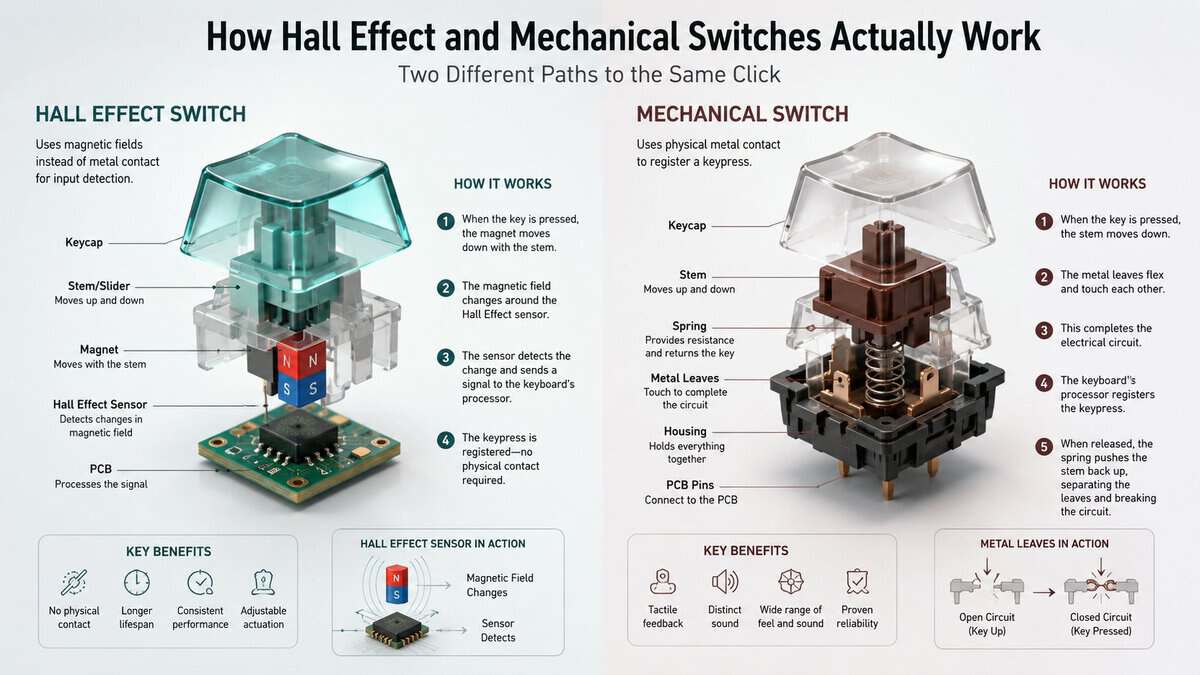
The important terms are simple once you strip away the jargon. Actuation point is where the key registers. Reset point is where it stops registering on the way back up. Debounce is the delay mechanical keyboards use to prevent chatter from noisy contacts. Rapid trigger lets a Hall effect key reset as soon as it starts moving upward instead of waiting for a fixed distance.
Why the physical design changes behavior
Because Hall effect doesn’t depend on metal contact, it can change actuation behavior in software. Mechanical switches are locked to the geometry of the switch itself, which is why their actuation and reset points stay fixed. Keebforce’s comparison explains that Hall effect boards can expose adjustable actuation and rapid trigger, with tuning down to 0.1 mm, while mechanical boards keep a fixed reset point and cannot dynamically shorten reset travel the same way. Keebforce Hall Effect vs Mechanical Keyboard Guide
That difference also affects maintenance. Fewer contact surfaces means less wear in Hall effect boards. Mechanical boards are easier to understand and often easier to tinker with, especially if you care about swapping switches or tuning feel. If you want the basics of mechanical switch upkeep before deciding, this mechanical keyboard switch breakdown is the right starting point.
Clean input design does not automatically mean a better typing experience. It just means the board behaves differently under your fingers.
Feel, Latency, and Sound Compared
Hall effect boards feel smoother. Mechanical boards feel more varied. That is the blunt version, and it is the version most buyers need.
Hall effect switches usually feel linear and muted because the sensing system is built around magnetic movement, not contact points. Mechanical boards can feel linear, tactile, or clicky, depending on the switch. That wider switch ecosystem is a real advantage if you know exactly what kind of feedback you like. If you want a quieter mechanical option, a guide on the quietest mechanical keyboard switches is more useful than chasing Hall effect just to reduce noise.
Latency matters most in repeated movement
A benchmark-style guide modeled a Hall effect board with rapid trigger at about 5.7 ms total reset latency versus about 13.3 ms for a standard mechanical board, which creates a 7.7 ms theoretical advantage in fast repeated inputs. The same model used a 150 mm/s finger-lift velocity, a 0.5 mm fixed reset distance, and a 5 ms debounce delay on the mechanical side to show where that advantage comes from. That matters in movement-heavy FPS play, especially for quick counter-strafes and repeated taps. Attack Shark Hall Effect vs High-End Mechanical Guide
For everyday typing, that gap is much less important. If you are drafting documents, chatting, or using shortcuts in a browser, your fingers are usually the bottleneck, not the switch tech. Mechanical boards still feel better to many typists because they offer more feedback styles, and that feedback can make long sessions less numb.
Sound is about more than loud or quiet
Neither category is automatically silent. Hall effect boards often sound cleaner because they avoid the contact chatter that worn mechanical switches can develop, but housing, plate, foam, and keycap choice still shape the final sound. Mechanical keyboards can be whisper-quiet or loud enough to annoy everyone in the room, depending on the switch and board design.
A lot of buyers compare keyboard tech the wrong way. They treat Hall effect like an SSD and mechanical like a hard drive, where one is clearly modern and the other is clearly legacy. That analogy is useful only up to a point. You can use solid state and hard drives as a mental model for how speed and responsiveness can matter, but keyboards are still about feel, sound, and daily comfort more than raw technical superiority.
Customization, Maintenance, and Availability
Hall effect customization is powerful, but narrow. Mechanical customization is broader, but more physical. That’s the core difference buyers need to understand before they spend more than they planned.
Hall effect boards support adjustable actuation, often from 0.1 mm to 4 mm, and rapid trigger behavior that starts resetting the moment the key moves upward. That makes them attractive if you want one board tuned for different games or different keys. Mechanical boards cannot do that kind of dynamic reset tuning in software. They stay fixed because the switch itself defines the behavior. For a deeper look at how the market is thinking about these features and the premium they command, the current question is not just speed, it is whether software features on cheaper boards justify the cost gap.
What you can change, and what you cannot
Mechanical keyboards give you more hardware freedom. You can swap switches, change keycaps, pick different sound profiles, and in many cases move to a hot-swap board without soldering. That ecosystem is still the main reason mechanical remains the hobbyist default. Hall effect boards give you software control instead, which is useful, but it is not the same kind of tinkering.
Maintenance is where Hall effect wins. No metal contacts means no oxidation on the sensing path, and less risk of dust-related problems. Mechanical boards can develop chatter or sticky switches after years of heavy use, and they may need cleaning or switch replacement. If you want the maintenance side of that reality spelled out in practical terms, this guide to cleaning a mechanical keyboard is worth keeping around.
- Hall Effect: better for buyers who want software tuning, cleaner input behavior, and less wear in the switch mechanism.
- Mechanical: better for buyers who want switch swapping, keycap variety, and a bigger modding world.
- Mixed reality: both categories can be built well, but board design matters more than logo hype.
Availability still favors mechanical by a wide margin. Hall effect is a smaller category, so you will see fewer mainstream options and fewer budget-friendly choices. That matters for shoppers who want one board for gaming, school, and work, because the value of a feature is lower when the purchase choices are limited.
If you like to tinker with feel, sound, and layout, mechanical still gives you the bigger playground.
| Attribute | Hall Effect | Mechanical |
|---|---|---|
| Input sensing | Magnetic, contactless | Physical contact |
| Actuation behavior | Fully adjustable, with rapid trigger support | Usually fixed actuation and reset |
| Durability | Typically 100 to 150 million actuations | Typically 50 to 100 million actuations |
| Dust and wear | More resistant to dust, debris, and contact wear | More exposed to wear and oxidation over time |
| Switch variety | Narrower, usually smoother and more linear | Much wider range of feel and sound |
| Best fit | Serious FPS and fast repeated inputs | Typing, MMO play, modding, broad value |
Which Type Fits How You Play
For FPS gaming, Hall effect is the cleaner pick if you are serious about movement-heavy play. Rapid trigger and adjustable actuation can help with repeated strafes and quick re-engagements, and that is exactly where Hall effect earns its reputation. If you mostly play Valorant, CS2, or Apex at a competitive level, Hall effect over mechanical is the easy call. For a practical shortlist, a dedicated board in the Hall effect class is the right place to start, and a focused reference like this hall effect keyboard guide can help you narrow the field.
For MMO and MOBA play, mechanical usually wins. Macro-heavy setups, more tactile feedback, and wider switch choice fit those games better than rapid trigger. Most MMO players want a board that feels deliberate and comfortable over a long session, not one optimized for the fastest possible reset. Hall effect can still work, but it is rarely the smarter buy for that workload.
Typing, streaming, and mixed use
Typing-heavy users, students, and writers should lean mechanical unless they have a very specific reason not to. Mechanical gives you more feel options, more sound control, and better value if the board spends a lot of time under your fingers for non-gaming work. Hall effect can feel slick and consistent, but that consistency does not automatically translate into better typing satisfaction.
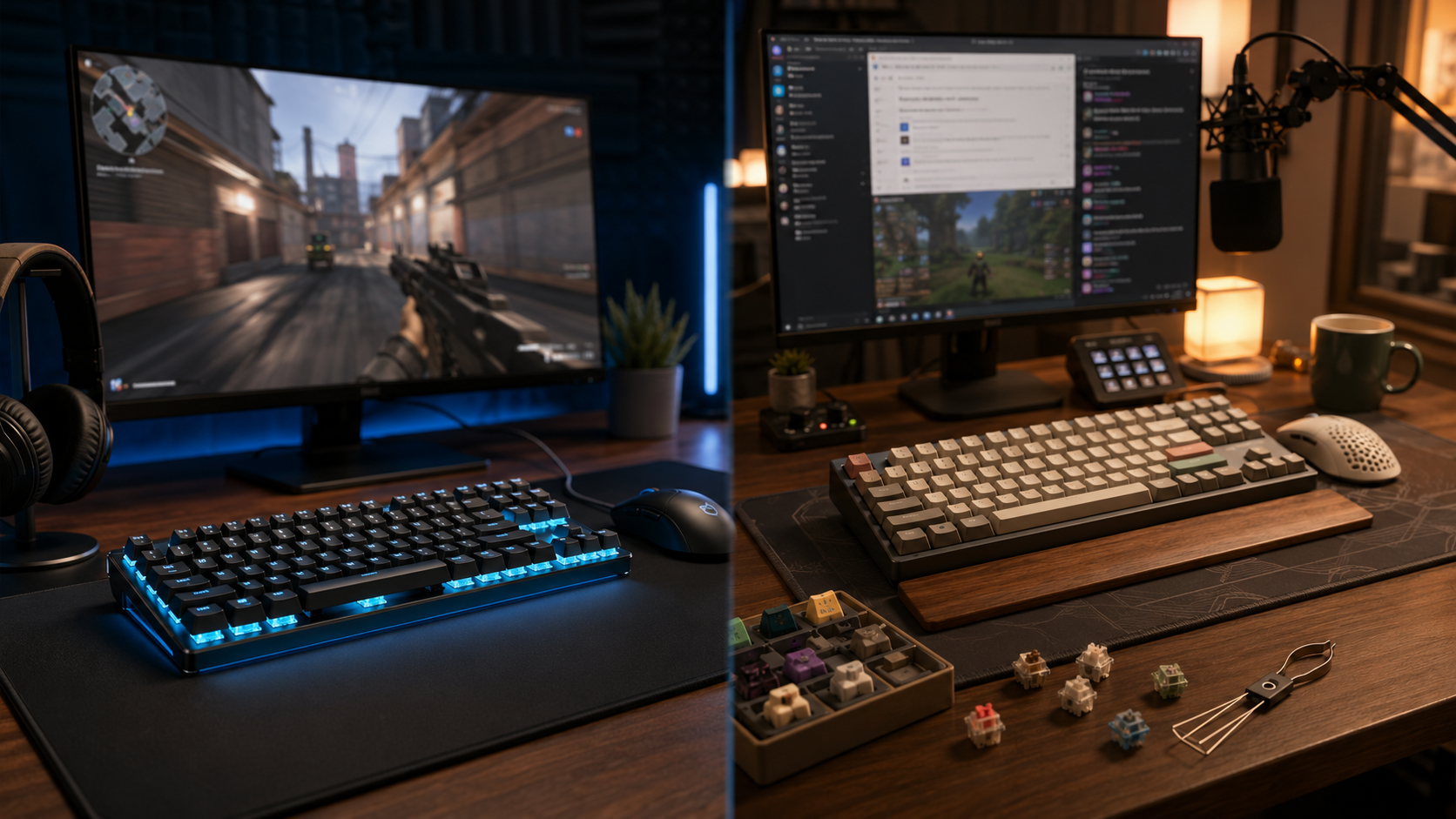
Streamers and mixed-use buyers need to ask one hard question: is this a dedicated gaming board or a daily driver? If it has to do both, mechanical is usually the safer choice because it handles long typing sessions, shortcuts, and casual gaming without asking you to pay extra for speed features you may barely use. If you want one setup that covers gaming and content work without overspending, Budget Loadout also publishes gear roundups and practical buying guides for value-focused setups, including its own recommendations inside the Hall effect category.
My blunt take: Hall effect is a specialist tool. Mechanical is the generalist that usually makes more sense for everyday life.
Price Tiers and What You Actually Get
Hall effect costs more because the sensor system and software stack cost more. That premium is real, even if it has been shrinking as more brands enter the space. Mechanical keyboards still dominate on value because they cover a much wider spread of budgets and feature sets.
Hall effect boards generally start in the upper half of the budget keyboard range and climb higher for models with good software and stable feature support, while mechanical keyboards stretch from entry-level boards near the low end to premium enthusiast models well above that. The exact number matters less than the pattern. Hall effect starts above the cheapest mechanical options, and that changes the value calculation for budget-conscious buyers.
To put names on those tiers: the Gamakay NS68 covers the budget Hall effect lane, the Keychron K2 HE holds the middle, and the SteelSeries Apex Pro TKL Gen 3 sits at the flagship end of the class. On the mechanical side, a board like the EPOMAKER x Aula F75 shows just how much keyboard the entry tier buys.
What your money buys in each category
At the lower end, mechanical wins easily. You get more layouts, more switch styles, and more opportunities to find a board that feels good without paying for niche gaming features. Hall effect boards at this level are still less common, so you are usually buying into a narrower ecosystem.
In the middle, the gap gets more interesting. A solid Hall effect board can make sense if you know you want rapid trigger and adjustable actuation. A solid mechanical board can still beat it if you care more about typing feel, noise tuning, or swapping parts later.
At the higher end, build quality becomes the primary comparison. Both categories now include boards built for heavy daily use, so don’t assume price alone guarantees longevity. Look at frame material, mount style, switch brand, and software support before you decide. Durability is part of the story, but it is not the whole story.
The smartest budget move is simple. Pay for Hall effect only when the features match how you play. Pay for mechanical when you want broader value and a board that stays flexible long after the first purchase.
Final Recommendation and Pick Guide
Choose Hall effect if you play competitive FPS seriously, care about Rapid Trigger, want adjustable actuation, and can justify the premium. That is the cleanest fit, and it is the one where Hall effect pays you back in practice. If that sounds like your setup, buy a board built around those features and stop chasing extra gimmicks.
Choose mechanical if you want the best value, the widest switch selection, stronger modding potential, or a keyboard that splits time between gaming and typing. That is the better default for most budget-conscious buyers. It is also the safer choice for MMO players, writers, students, and mixed-use setups where comfort matters more than the last bit of input speed.
Do not buy Hall effect just because it sounds more advanced. If you are casual in FPS games, the advantage often stays theoretical while the cost is very real. Spend your money where you will feel it every day, not where the spec sheet looks coolest.
Frequently Asked Questions
Quick answers to the questions buyers ask most in the hall effect vs mechanical debate.
Are hall effect keyboards better than mechanical for gaming?
They are better for competitive FPS play, where rapid trigger and adjustable actuation genuinely change counter-strafing and repeated inputs. For MMOs, casual play, and mixed gaming and typing, a good mechanical board delivers the same practical experience with more choice and better value.
Do hall effect keyboards last longer than mechanical keyboards?
On paper, yes. Magnetic sensing is contactless, so switches are typically rated around 100 to 150 million actuations versus 50 to 100 million for mechanical, and they resist dust and contact wear better. In practice both technologies outlast the typical upgrade cycle of a gaming keyboard.
Can you hot-swap switches on a hall effect keyboard?
Only with compatible magnetic switches, and the pool is much smaller than the mechanical ecosystem. If deep switch customization and a wide aftermarket matter to you, mechanical hot-swap boards remain the stronger platform.
Is rapid trigger actually worth it?
It is worth it if you play movement-heavy shooters like Valorant, CS2, or Apex at a level where counter-strafe timing decides fights. Casual FPS players and everyone outside the genre rarely feel the difference, which is why the feature alone should not drive the purchase.
Do hall effect keyboards feel different to type on?
Most magnetic switches are smooth and linear, so typists who like tactile bumps or clicky feedback will find far fewer options than in the mechanical world. For long typing sessions the feel is closer to a linear mechanical switch than to anything new.
If you want a straight, value-first follow-up, Budget Loadout publishes practical keyboard guides and gear recommendations built around how people actually play, not hype. Visit Budget Loadout if you want a cleaner shortlist for your budget, your games, and the kind of keyboard you’ll enjoy using.
Related Articles